The Insider/
Kemerton to close. What’s next for critical minerals?
Albemarle’s decision to idle its Kemerton lithium hydroxide plant near Bunbury is extremely disappointing. Not only due to the 250 jobs lost, the economic impact on South West communities, but also because of what it might mean to the State Government’s ambitious diversification agenda – a sign that future downstream processing is doomed to fail?
Some commentary was predictable: proof that value-adding is wishful thinking, that the Federal Government’s Critical Minerals Strategy is built on sand, that we should go back to digging and shipping.
That’s the wrong lesson, and potentially a dangerous one.
WA is sitting on one of the world’s great mineral endowments
Critical minerals is not a niche sector looking for a role.
Western Australia is home to one of the most extraordinary concentrations of critical mineral wealth on the planet – and much of it remains under-explored.
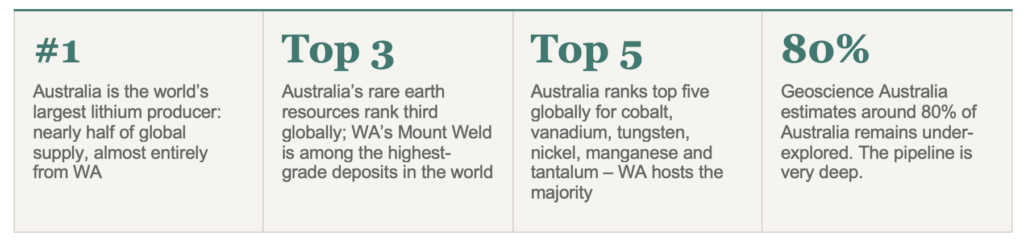
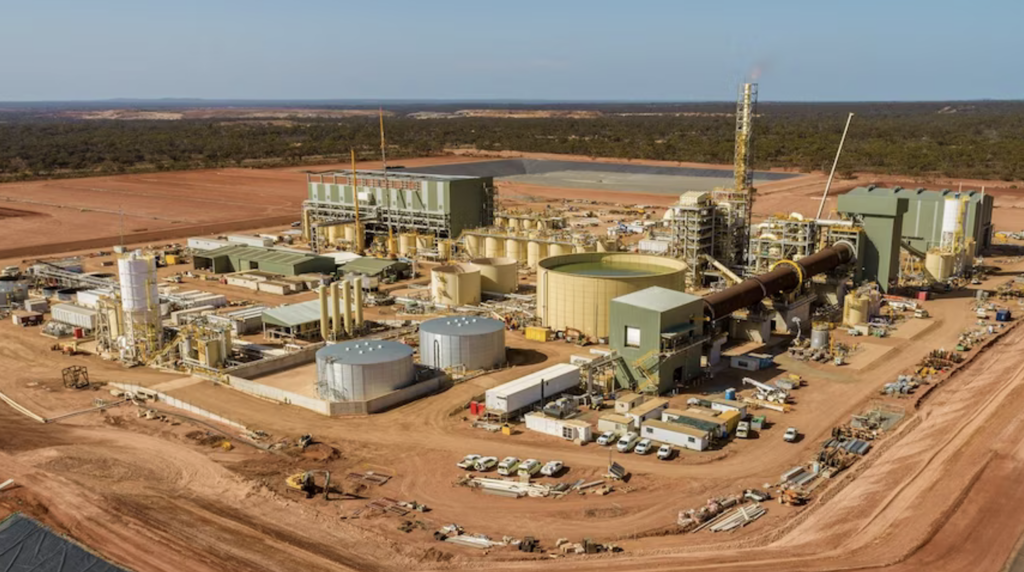
WA is home to the world’s largest hard-rock lithium mine at Greenbushes, world-class nickel deposits in the Goldfields and Pilbara, and significant vanadium and manganese resources across the State. Lynas Rare Earths’ Mount Weld operation, now supported by its Kalgoorlie processing facility, already forms the backbone of the only significant rare earth supply chain outside of China – and saw a jump in profits off the back of this.
These are not aspirational assets. They are proven, operating foundations for a much larger processing industry.
This isn’t just an economic story
The critical minerals debate has been framed as a jobs story, a value-adding story, a diversification story. These are legitimate goals, but they completely undersell what is at stake.
“What happens when a single nation controls the materials that underpin modern defence and advanced technology and decides to use that control as leverage?”
We don’t have to imagine it. The concentration of rare earth mining and processing capacity within a single nation and the use of export restrictions as a trade lever (as occurred in 2025) has already demonstrated the fragility of supply chains that lack diversity. Add to that the dominance of global tungsten supply by one producer, and the vulnerability of our defence and technology supply chains becomes clear.
That is the vulnerability WA’s extraordinary mineral endowment is uniquely positioned to address – if we can encourage the expansion of our critical minerals industry.
AUKUS changes the equation
The basing of nuclear-powered submarines at HMAS Stirling, and the significant expansion of naval infrastructure flowing from that commitment, means WA is becoming one of the most strategically important defence locations in the Indo-Pacific. The materials needed to build, maintain and operate that capability must come from supply chains our partners can actually trust.
“The alignment between WA’s minerals endowment and its emerging role as an anchor of allied naval capability in the region is not a coincidence. It is an opportunity.”
The policy architecture to act on that opportunity is already in place. The Federal Government’s Critical Minerals Strategy 2023–2030, the $17.6 billion Critical Minerals Production Tax Incentive, the US-Australia Critical Minerals Partnership formalised in late 2025, and Australia’s Minerals Security Partnership arrangements with the UK and other AUKUS partners are serious, well-considered commitments that deserve genuine recognition – and persistent activation.
The most urgent processing priorities are where allied dependency on concentrated supply is greatest:
- Rare earths for defence systems, EV motors and clean energy; WA’s Lynas operation already demonstrates it can be done at scale outside of China
- Tungsten for advanced manufacturing and precision defence equipment; a near-monopoly in supply is an acute vulnerability for every AUKUS partner – and we have some of the largest, accessible deposits on earth.
- Vanadium and nickel for battery storage, defence alloys and advanced manufacturing; WA holds world-class deposits that remain substantially underdeveloped for downstream processing – but with companies like Australian Vanadium (AVL) looking to integrate mining and processing facilities to prepare vanadium for export and supply long-duration batteries right here in WA.
Let industry lead: with government making it easier
Perth is, without exaggeration, one of the world’s great mining capitals. Australia holds the number one global ranking for mining investment attractiveness. The ASX resources sector and the depth of specialist project finance expertise here represent one of the deepest pools of mining capital anywhere. The machinery to fund the next chapter of this industry already exists in this city.
“Industry doesn’t need to be told how to build complex processing facilities. It needs the confidence that when it does, markets and partners will be there.”
The existing policy frameworks provide a strong foundation. Building on them creatively could unlock the private capital currently waiting for the right conditions:
- Streamlined approvals: accelerating the process without compromising standards would reduce the time and cost burden that currently deters early movers on processing projects
- Concessional finance: Export Finance Australia and the $4 billion Critical Minerals Facility are the right instruments; expanding access to cheap credit for processing projects would de-risk entry points and draw in private capital at scale.
- Stockpile offtake: Australia, US, UK and Japan are actively building strategic mineral reserves; formalising long-term offtake arrangements for Australian-processed material would provide the demand certainty that transforms processing project economics and gives private investors the confidence to commit.
The Kemerton closure will be used by some as a reason to walk back our ambitions. The opposite response is warranted. The policy direction is right. The relationships with our largest defence allies are strengthening. WA holds the geology, the proven industry capability and the capital markets infrastructure to deliver. The creative challenge now is connecting those assets and turning a world-class strategy into projects in the ground.
WA is not a peripheral player in the global competition for critical mineral supply chain security. Given what sits beneath this state’s feet, and what is being built in the waters off its coast, it may be the most important one.
Anyone watching the shipping lanes connecting WA’s ports to the rest of the world, knows that the pressure to get this right is already here.
Image: Lynas Rare Earths Kalgoorlie Processing Facility. Source: ABC News