
The Insider/
Community Engagement: Getting in the Zone
Every project sits at the intersection of three forces: what the community expects, what the regulator requires, and what the organisation is trying to achieve. None of these are fixed. Move one and the other two shift, and not always in the direction you expect or intend.
In physics the three-body problem describes what happens when three objects with gravity pull on each other. Most projects sit inside a version of this.
A shift in community sentiment can alter what a regulator is willing to accept as sufficient engagement. A shift in regulatory settings often changes what a community is prepared to tolerate. A more ambitious organisational goal changes what both are being asked to accept. Treating any one of the three as fixed risks misreading the other two.
In previous editions of The Insider, we introduced this concept. This time, we unpack what happens when these three forces overlap and why early community engagement is worth the investment.
Four zones, four realities
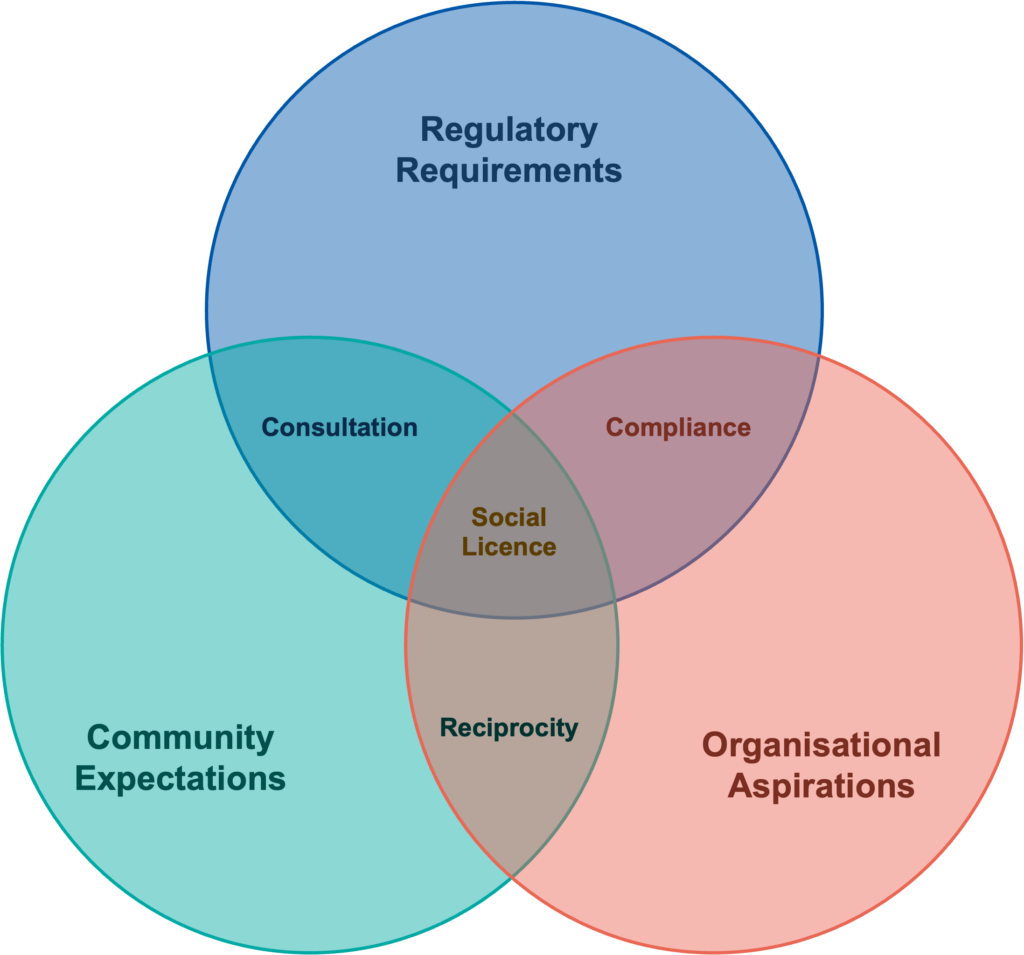
Here are the three overlapping circles: community expectations, regulatory requirements, and organisational aspirations.
This overlap creates four distinct zones, each describing a different relationship and the interests driving those relationships, and each carrying its own risks and benefits.
Where community and regulator overlap there is Consultation without commitment. Engagement happens and is documented because the regulator requires evidence of it, but what is missing is any organisational appetite to act on what was heard. It is efficient, defensible, and exactly the kind of engagement that is described as extractive: information gathered from people who come away with nothing to show for it.
With community and organisation, the result is Reciprocity without protection. An organisation that goes beyond any statutory requirement to build trust and share benefits is demonstrating genuine goodwill. The vulnerability is that nothing protects it. With no regulatory requirement holding it in place, reciprocity achieved and maintained through dedicated community relations resourcing often becomes the first thing cut when a project comes under cost or schedule pressure.
Finally, the regulator and organisation overlap is Compliance without social licence. Technical studies may satisfy every regulatory requirement but satisfying them does not confirm whether the community actually supports the project. The risk is a false sense of sufficiency where a organisation can be fully compliant and still face community opposition.
Only one position holds all three forces at once. Social Licence is the only zone that endures beyond the build because community expectations, regulatory requirements, and organisational aspirations are being addressed together, not simply left to coexist.
Why the gap persists
This is not a criticism of regulation, and it is worth being clear about that. Regulations can standardise the consultation, compliance and reciprocity, but none of them can standardise social licence. Meeting a minimum standard is not the same as minimum effort when it comes to community relations. Closing this gap requires community engagement to begin in the early stages of project development and continue well beyond approvals.
Where community engagement fits
Early community engagement does not create social licence by itself, but it does pull the three forces closer together.
In compliance, it makes an organisation’s aspirations visible to the community that otherwise would not see past the compliance paperwork. In reciprocity, it extends existing relationships and goodwill to include the hard conversations, not just the easy wins. And in consultation, it demonstrates that the organisation’s aspirations are genuine and go beyond a box-ticking exercise.
Organisations are then faced with deciding the most appropriate type and level of community engagement, anything from baseline surveys and facilitated community reference panels through to full-blown social impact assessments. And it changes over time.
In practice, community engagement means identifying who is affected and what matters to them. It means sitting down with the broadest cross-section of community stakeholders to understand the existing context – their history with development, their concerns about cumulative impacts, and their expectations.
It also means being honest about what is not on the table. Engagement is not about consulting on everything, it is about being clear on what communities can genuinely influence and making sure that influence is real. Organisations that do this well treat the information gathered as project-critical, carrying the same weight as geotechnical data or a feasibility study.
Brought forward, community engagement does not just resolve tensions in the zones, it widens the space where they overlap and gives Social Licence more room to grow. In previous editions of The Insider, we discussed the relevance and importance of social licence in project development.
How this is playing out right now
Draft reforms now moving through WA’s planning system are live examples. A new technical code setting the standards that renewable energy projects must meet alongside a separate amendment that would make assessment by the WA Planning Commission mandatory for projects above a certain threshold. While the details may still change before the reforms are finalised, the underlying concept will not. As every proponent converges on the same regulatory floor, early engagement becomes the genuine point of difference and determines whether projects are still standing on solid ground after approval.
Key takeaways
- Begin community engagement well before any regulatory trigger,
- Convert early engagement into a live management plan carried through approvals, construction, and operations,
- Position early engagement as a key point of difference: compliance is standard, engagement is not, and
- Frame early engagement as protection against future opposition and reputational damage.
From stakeholder mapping through to social impact assessments, ReGen Strategic works with clients to address the three-body problem by identifying the appropriate timing, type and level of engagement needed to ease tensions across the four zones. Our work helps clients enhance and protect social licence, mitigate the risks to cost and schedule, and build lasting stakeholder relationships.